
Publications
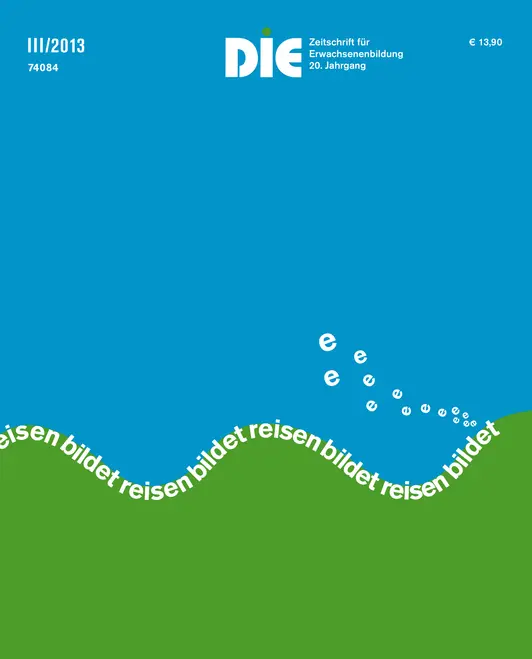
Reisen bildet
wbv
Reisen bildet
DIE Zeitschrift für Erwachsenenbildung
7/2013
Bielefeld
Abstract
Im Motto »Reisen bildet« trifft eine pädagogische Binsenweisheit auf einen Slogan der Tourismusindustrie. In unserem Sommerheft fragen wir genauer nach: Unter welchen Bedingungen hat eine Reise ein bildendes Potenzial? Welche Kompetenzen lassen sich auf Reisen erwerben? Es spricht einiges dafür, dass gerade das individuelle Reisen neben der organisierten Bildungsreise ein Potenzial hat, das unter den Vorzeichen des lebenslangen Lernens eine vertiefte Betrachtung verdient.
Content
Dr. Peter Brandt; Prof. Dr. Ada Pellert
»Die DUW ist kein Flop!« 3/2013
DIE-Interview zur Zukunft der Deutschen Universität für Weiterbildung nach Verkauf an Steinbeis
»Die DUW ist kein Flop!« 3/2013
DIE-Interview zur Zukunft der Deutschen Universität für Weiterbildung nach Verkauf an Steinbeis
Dr. Peter Brandt; Joachim Höper
Erster Open-Access-Titel in DIE-Buchreihen 3/2013
wbv und DIE beschreiten neue Publikationswege
Erster Open-Access-Titel in DIE-Buchreihen 3/2013
wbv und DIE beschreiten neue Publikationswege
Dr. Peter Brandt
Stichwort »Reise und Bildung« 3/2013, S. 20–21
Stichwort »Reise und Bildung« 3/2013, S. 20–21
Dr. Peter Brandt; Frano Illic
»Wir sind kein pädagogisches Unternehmen« 3/2013, S. 22–24
Gespräch mit Frano Illic über Studiosus Reisen
»Wir sind kein pädagogisches Unternehmen« 3/2013, S. 22–24
Gespräch mit Frano Illic über Studiosus Reisen
Alfred Schäfer
Erkundungen von Fremdheit und Andersheit 3/2013, S. 25–28
Bildende Erfahrungen von Individualreisenden in Mali und Ladakh
Erkundungen von Fremdheit und Andersheit 3/2013, S. 25–28
Bildende Erfahrungen von Individualreisenden in Mali und Ladakh
Empirically based on interviews, the article gets to the bottom of how independent travelers address their educational experiences. Visitors of the Dogon people in Mali are confronted with an inaccessible unfamiliarity, whereas voyagers to Ladakh are irritated by the prevalent differences inducing the reflection of their individual experiences. Educational qualities can be attributed to both forms of experience.
Franziska Krämer; Marcus Haase
Orientierungsveränderungen bei Work&Travel-Reisenden 3/2013, S. 29–32
Die Reise als Bildungsraum im Licht strukturaler Bildung
Orientierungsveränderungen bei Work&Travel-Reisenden 3/2013, S. 29–32
Die Reise als Bildungsraum im Licht strukturaler Bildung
This article is based on the significance of informal forms of learning in the context of lifelong learning as well as the structural educational theory following Marotzki. The authors sum up qualitative-empirical research findings on orientational changes of travel workers – young adults – while visiting and working in foreign countries to finance their journey. On this base, structural aspects of these journeys are identified, which can create an educational space: critical experiences, autotelic action, a longer journey period, as well as an exit option.
Eva Dalhaus
Mehrdimensionaler Kompetenzzuwachs 3/2013, S. 33–35
Kompetenzentwicklung am Beispiel der Sprachreisen der Carl Duisberg Centren
Mehrdimensionaler Kompetenzzuwachs 3/2013, S. 33–35
Kompetenzentwicklung am Beispiel der Sprachreisen der Carl Duisberg Centren
In her dissertation, the author collected and evaluated self-assessments of language study travellers travelling with Carl Duisburg Centres. 90 participants were questioned quantitatively. In addition to the expected competence improvement of foreign languages, the flexibility and mobility as well as intercultural competences were increased. The competence acquisition in connection to the participants’ individual ages was investigated in a supplementary qualitative research.
Prof. Dr. Sigrid Nolda
Anleitung für die Aneignung der Fremde 3/2013, S. 36–38
Reiseführerliteratur als Medium der Erwachsenenbildung
Anleitung für die Aneignung der Fremde 3/2013, S. 36–38
Reiseführerliteratur als Medium der Erwachsenenbildung
Guide books provide instructions for the discovery and exploration of new environments. The author identifies educational functions such as selection and directed attention to prepare the object for appropriation. Using pictures, guide books direct the attention to things which are supposedly worth seeing thus functioning as a visual guide. At the same time, in all identifying functions the author draws attention to the medium’s limitation and identifies the resulting limitations to appropriation.
PD Dr. phil. Marion Fleige
Weiterbildung im Sozialraum 3/2013, S. 45–47
Kategorien für die Modellierung sozialräumlicher Bildungspartizipation in erwachsenendidaktischer Perspektive
Weiterbildung im Sozialraum 3/2013, S. 45–47
Kategorien für die Modellierung sozialräumlicher Bildungspartizipation in erwachsenendidaktischer Perspektive
The report covers approaches for research and modeling an orientation to social spaces of educational facilities in synergy with real-world oriented search for education. According to the author, it is based on four central categories: living environments, educational spaces, thematic portals and learning cultures. The analyses of educational participation in social spaces from a meso and macro didactical perspective, based on educational theories, can support the identification of educational interests in a geographical area and the stimulation with the targeted development of educational spaces as well as programme planning.