
Publications
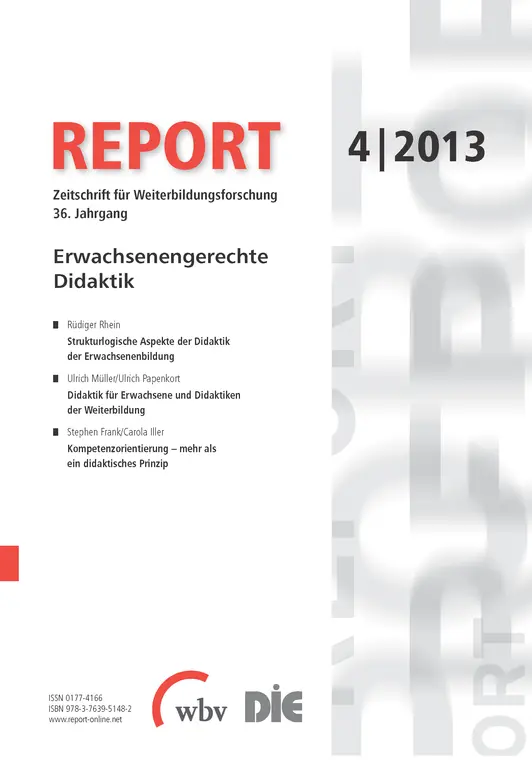
Erwachsenengerechte Didaktik
wbv
Erwachsenengerechte Didaktik
REPORT Zeitschrift für Weiterbildungsforschung
12/2013
Bielefeld
Abstract
Erwachsene sind unbelehrbar, aber lernfähig, so Horst Siebert. Sie lernen anders als Kinder und Jugendliche und bedürfen daher anderer Formen der Aneignung von Wissen, der Unterweisung und Kenntnisvermittlung. Wie gerechtfertigt ist dieses Paradigma der Erwachsenenbildung und welche Rolle spielen Inhalte? Inwiefern sind Lehrpläne und fachliche Analysen, darüber hinaus fachdidaktische Wissensbestände hilfreich? Ist eine gesonderte Didaktik für Erwachsene überhaupt gerechtfertigt? Diesen Fragen geht die aktuelle Ausgabe des REPORT nach.
Content
Rüdiger Rhein
Strukturlogische Aspekte der Didaktik der Erwachsenenbildung 4/2013, S. 11–21
Strukturlogische Aspekte der Didaktik der Erwachsenenbildung 4/2013, S. 11–21
This contribution suggests a reconstruction of didactic behavior in the context of adult education. Didactics is perceived as a specific kind of practice that can be analyzed with respect to its immanent significances. Thus, criteria of adult education didactics can be identified. These criteria are not only empirically found aspects concerning the conditions of success. Incorporated challenges concerning disciplining, impositions of teaching and authority matter as well. Notwithstanding adult education has to deal with these aspects and to design a form of managing adult education requirements.
Ulrich Papenkort; Ulrich Müller
Didaktik für Erwachsene und Didaktiken der Weiterbildung 4/2013, S. 22–31
Didaktik für Erwachsene und Didaktiken der Weiterbildung 4/2013, S. 22–31
The article discusses whether it is necessary and possible to deduce the didactics of adult education from the particularities of the adult age. The authors make the case for understanding didactics of adult education in the continuity of the lifespan and as a modification of general didactics. It should be related to the characteristics of the social situation of adults. Such “didactics for adults” should be complemented by specific “didactics of further education” which focus on specific institutional aspects: didactics of certificate-related, scientific, practical, interest-based, and target-group oriented further education.
Stephen Frank; Dr. Carola Iller
Kompetenzorientierung – mehr als ein didaktisches Prinzip 4/2013, S. 32–41
Kompetenzorientierung – mehr als ein didaktisches Prinzip 4/2013, S. 32–41
The concept of competencies has expansive effects for the definition of goals, contents and methods in teaching. The orientation on competencies therefore is more than a didactic principle like active-learning or learner-centered instruction. Coming from a concept of competencies as a didactical category as well as an aim of teaching, we will argue, that a comprehensive theoretical approach is needed, which delivers a theoretical founded orientation for both the decisions on contents and the methods.
Rainer Silberbauer
Entstehung von Erinnerung in kommunikativen Prozessen im Kontext der Amateurfotografie 4/2013, S. 45–65
Entstehung von Erinnerung in kommunikativen Prozessen im Kontext der Amateurfotografie 4/2013, S. 45–65
Using the documentary method according to Ralf Bohnsack, it is shown in this essay how memory in communicative processes with senior citizens develops. Amateur photographs were used to discuss with the seniors. The conversations took place in two small groups and were analyzed in comparison. Furthermore, the statements of the interviewees were evaluated and discussed in the light of relevant literature.