
Publications
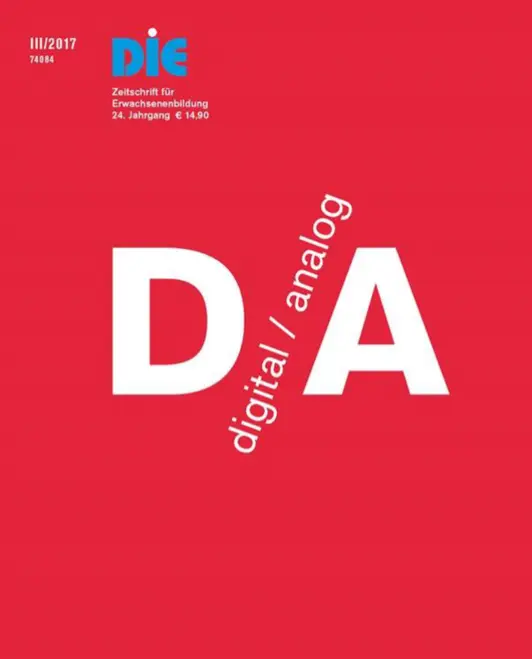
Digital/Analog
wbv
Digital/Analog
DIE Zeitschrift für Erwachsenenbildung
7/2017
Bielefeld
Content
Dr. Petra Hetfleisch
»Theoretisch wie methodisch anspruchsvoll« 3/2017, S. 12
Internationale Fachtagung »Research on Intervention and Implementation in Education«
»Theoretisch wie methodisch anspruchsvoll« 3/2017, S. 12
Internationale Fachtagung »Research on Intervention and Implementation in Education«
Jan Rohwerder
Stichwort »Digital« 3/2017, S. 22–23
Stichwort »Digital« 3/2017, S. 22–23
Christian Sellmann; Jan Rohwerder
»Der gute Lehrer rückt wieder mehr in den Vordergrund« 3/2017, S. 24–26
Im Gespräch mit Christian Sellmann über Chancen und Grenzen des Online-Lernens
»Der gute Lehrer rückt wieder mehr in den Vordergrund« 3/2017, S. 24–26
Im Gespräch mit Christian Sellmann über Chancen und Grenzen des Online-Lernens
Prof. Dr. Dr. Friedrich W. Hesse
Digitalisierte Lehr-/Lernprozesse neu denken! 3/2017, S. 27–29
Über die Notwendigkeit einer kognitiven Schnittstelle
Digitalisierte Lehr-/Lernprozesse neu denken! 3/2017, S. 27–29
Über die Notwendigkeit einer kognitiven Schnittstelle
New ideas for supporting the human working memory are required to take advantage of the options of teaching/learning processes provided by digitalisation. A new "cognitive interface" is necessary for connecting human knowledge with the knowledge of digital resources.
Klaus-Peter Hufer
Lob des Analogen 3/2017, S. 30–31
Warum Lernen nicht immer digital sein muss
Lob des Analogen 3/2017, S. 30–31
Warum Lernen nicht immer digital sein muss
The use of new digital techniques and media in class is almost socially mandatory. In his interjection, Klaus Peter-Hufer points out the advantages of programmes that do completely without digital media. Particularly text work are tactile and sensory processes, which are difficult to transfer into digital processes.
Ingrid Schöll
(Keine) Zeit für Experimente 3/2017, S. 32–34
Beobachtungen zur Digitalisierung der Volkshochschulen
(Keine) Zeit für Experimente 3/2017, S. 32–34
Beobachtungen zur Digitalisierung der Volkshochschulen
Continuing digitalisation is a macrosocial phenomenon – dealing with it is a macrosocial task. For the educational field, it does not only concern a change of teaching-learning situations due to digital media but also the issue of contributing to the changing situation - without excluding certain groups. According to the author, the issue of digitalisation does not allow federal disputes and segment-specific separation of educational areas.
Dr. Karin Julia Rott; Ricarda Bolten; Prof. Dr. Matthias Rohs; Prof. Dr. Bernhard Schmidt-Hertha
Fit für die digitale (Lern-)Welt? 3/2017, S. 35–37
Medienpädagogische Kompetenzanforderungen an Erwachsenenbildner/innen
Fit für die digitale (Lern-)Welt? 3/2017, S. 35–37
Medienpädagogische Kompetenzanforderungen an Erwachsenenbildner/innen
The development of digital media continuously provides new opportunities for developing teaching/learning processes. As a result, the media educational requirements for teachers to assess the relevant chances and risks and to use digital media effectively as a learning support, is growing. The article points out the demand for paying increased attention to this specific competence. It presents a media educational competence model for adult educators, which was developed on a theoretical and empirical basis.
Dr. Karin Julia Rott; Ricarda Bolten; Prof. Dr. Matthias Rohs; Prof. Dr. Bernhard Schmidt-Hertha
Dr. Thomas Jung
Was bleibt, wenn die Bücher gehen? 3/2017, S. 38–41
Betrachtungen zum Wandel der Buchkultur
Was bleibt, wenn die Bücher gehen? 3/2017, S. 38–41
Betrachtungen zum Wandel der Buchkultur
The Gutenberg era is coming to an end. Caused by the expansion of digital media and progressing networking opportunities, another technical revolution after the invention of the printing press is forthcoming – "the secondary orality". The author points out the effects on both publishers and the entire academic and learning culture.
Felix Lukowski
Anspruchsvoller arbeiten, mehr lernen? 3/2017, S. 42–44
Betriebliche Weiterbildung in Zeiten von Digitalisierung
Anspruchsvoller arbeiten, mehr lernen? 3/2017, S. 42–44
Betriebliche Weiterbildung in Zeiten von Digitalisierung
Nowadays, employees are part of a rather dynamic working environment, which is significantly marked by increasing digitalisation. As a result, qualification and competence requirements as well as job contents are changing. Findings by the qualification panel of the Federal Institute for Vocational Education and Training (BIBB) indicate that a company's higher digitalisation level requires higher skill profiles. More digitalised companies also have a larger number continuing education measures, which reveals the aspiration to prepare employees for the digital change.
Gerhard Quincke
Erwachsenenbildungszentren in Mali 3/2017, S. 46–48
Erfahrungen und Konzepte in und nach der Krise
Erwachsenenbildungszentren in Mali 3/2017, S. 46–48
Erfahrungen und Konzepte in und nach der Krise
The article presents experiences gained in educational work in (post) crisis areas based on the work conducted by the DVV in Mali. According to the findings, adult education centres can be successful providers of holistic education programmes. In addition, conditions and factors for success are presented.