
Publications
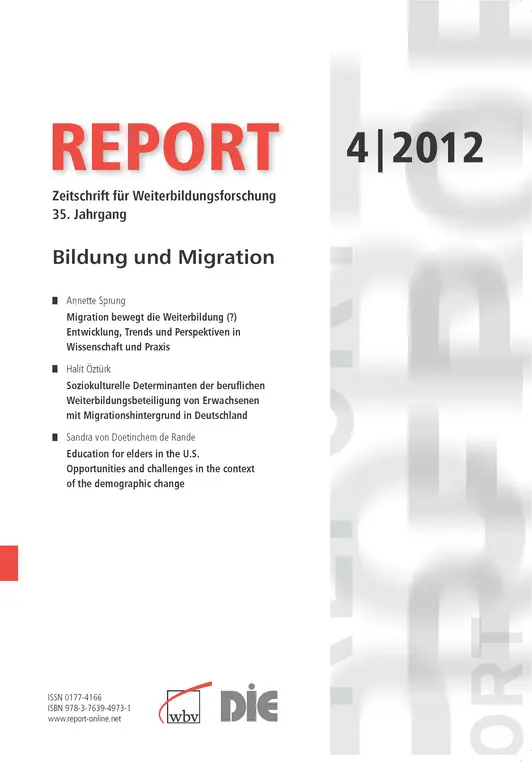
Bildung und Migration
wbv
Bildung und Migration
REPORT Zeitschrift für Weiterbildungsforschung
12/2012
Bielefeld
Abstract
Immigration countries such as Germany require legal, social and educational measures to organize migration. Both, the immigrant as well as the host population need to be the concern of educational and training activities. Linguistic, intercultural and political educational programmes are particularly relevant. The REPORT on “Continuing Education and Migration” focuses on empirical research findings and implemented concepts: What are the key issues in continuing education to be tackled within the context of migration? Which approaches have been pursued? Which concepts were developed?
Content
Annette Sprung
Migration bewegt die Weiterbildung 4/2012, S. 11–20
Entwicklung, Trends und Perspektiven in Wissenschaft und Praxis
Migration bewegt die Weiterbildung 4/2012, S. 11–20
Entwicklung, Trends und Perspektiven in Wissenschaft und Praxis
Adult education is more and more affected by social change due to migration. This paper analyses the marginal adoption of the topic by research in the past and describes recent trends, also in practice. Perspectives for institutions of adult education such as widening access to adult education for migrants, organisational development and professionalisation are discussed. Furthermore the author names challenges for research. There should be more cooperation within the field of educational research, especially between scholars of adult and intercultural education. Research should be based on critical approaches from migration studies. The contribution of research to processes of othering and the reproduction of racist structures should be reflected intensely.
Professor Halit Öztürk
Sozio-kulturelle Determinanten der beruflichen Weiterbildungsbeteiligung von Personen mit Migrationshintergrund in Deutschland 4/2012, S. 21–32
Eine empirische Analyse mit den Daten von SOEP
Sozio-kulturelle Determinanten der beruflichen Weiterbildungsbeteiligung von Personen mit Migrationshintergrund in Deutschland 4/2012, S. 21–32
Eine empirische Analyse mit den Daten von SOEP
The demographic change and the growing demand of skilled workers in Germany puts workers with migration background in the focus of interest in politics, economy, research and, increasingly, of adult education. The following article analyses empirically the relationship between the socio-cultural determinants, which are theoretically embedded in Esser’s model of social integration, and the participation in further vocational education of working adults with a migration background in Germany on the basis of the German Socio-Economic Panel. The study shows that the participation barriers especially for first generation immigrants can be explained by socio-cultural determinants, especially German language skills, professional placement and social networks.