
Publications
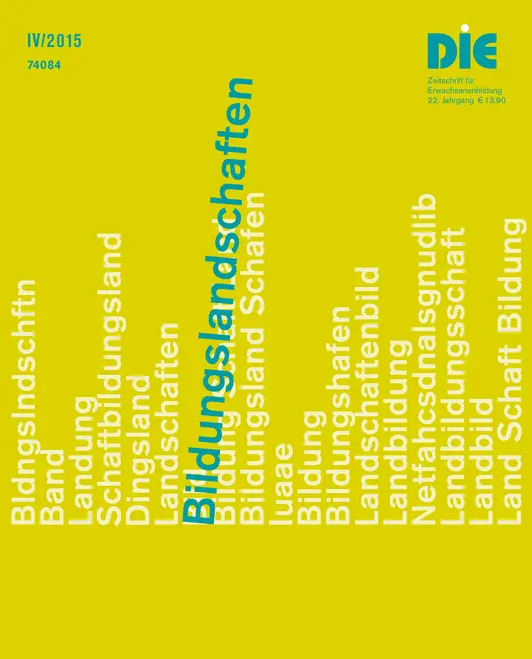
Bildungslandschaften
wbv
Bildungslandschaften
DIE Zeitschrift für Erwachsenenbildung
10/2015
Bielefeld
Abstract
Die Kooperation von (Weiter-)Bildungseinrichtungen gilt als zentrale Strategie, um den Herausforderung in Stadt und Land zu begegnen. Auf diese Weise können Kompetenzen und Ressourcen gebündelt werden, um komplexe Aufgaben zu bewältigen, mit denen die einzelnen Einrichtungen überfordert wären. Auch Wirtschaft und Politik haben längst erkannt, dass gut ausgebildete Menschen bzw. gute Weiterbildungsoptionen wichtige Standortfaktoren sind – und beziehen diese in Stadt- und Regionalentwicklung mit ein. Vor diesem Hintergrund beschäftigt sich das Heft mit folgenden Fragen: Wie sehen regionale Bildungslandschaften aus? Gibt es Vorbilder guter Praxis? Und wie werden Regional- bzw. Stadtentwicklung und Erwachsenenbildung miteinander verknüpft?
Content
Prof. Dr. Rudolf Tippelt
Stichwort: »Bildungslandschaften« 4/2015, S. 20–21
Stichwort: »Bildungslandschaften« 4/2015, S. 20–21
Dr. Peter Brandt; Klaus Jensen; Rudolf Fries; Theresa Jung
»Bildungsmanagement zur politischen Priorität erklären!« 4/2015, S. 22–24
Im Gespräch mit den Architekten der kommunalen Bildungslandschaft in Trier
»Bildungsmanagement zur politischen Priorität erklären!« 4/2015, S. 22–24
Im Gespräch mit den Architekten der kommunalen Bildungslandschaft in Trier
Dr. Peter Brandt; Klaus Jensen; Rudolf Fries; Theresa Jung
Prof. Dr. Richard Stang
Perspektiven für eine bildungsorientierte Stadtentwicklung 4/2015, S. 25–27
Neue Institutionen für Bildung
Perspektiven für eine bildungsorientierte Stadtentwicklung 4/2015, S. 25–27
Neue Institutionen für Bildung
The article presents the European development of new learning centres as well as educational and cultural centres, in which adult education institutions and libraries continue to merge. The author depicts three examples of these new institutions, which are increasingly becoming an element of educational urban development.
Prof. Dr. Richard Stang
Prof. Dr. Andreas Martin; Prof. Dr. Klaus Schömann
Weiterbildung in den Regionen 4/2015, S. 28–30
Möglichkeiten und Herausforderungen der Raumanalyse
Weiterbildung in den Regionen 4/2015, S. 28–30
Möglichkeiten und Herausforderungen der Raumanalyse
The article provides an insight of the opportunities and challenges of analysing spatial aspects in continuing education including the various concepts of spatial references. Regional continuing education characteristics are presented based on initial findings of the German Continuing Education Atlas.
Prof. Dr. Andreas Martin; Prof. Dr. Klaus Schömann
Nina Lichte; Svenja Krämer
Kooperation und Konkurrenz in städtischen Lernräumen 4/2015, S. 31–33
Zum Umgang mit Konkurrenzen und Konflikten
Kooperation und Konkurrenz in städtischen Lernräumen 4/2015, S. 31–33
Zum Umgang mit Konkurrenzen und Konflikten
Various needs and requirements need to be taken into account for developing urban educational spaces. At the same time, the demand for cooperation between educational and cultural institutions creates obvious and concealed competition between educational and cultural planners. Based on a scientific project support, this article provides guidance on the causes and handling of potential competition.
Nina Lichte; Svenja Krämer
Lina Trautmann
Bildungsnetzwerke der Erwachsenenbildung 4/2015, S. 34–36
Beitrag zur Regionalentwicklung
Bildungsnetzwerke der Erwachsenenbildung 4/2015, S. 34–36
Beitrag zur Regionalentwicklung
Considering current large-scale developments, the author takes a look at the supervision of spatial development processes as well as the opportunities and potentials of adult education networks for regional development.
Lina Trautmann
Heinz H. Meyer
Vernetzung in der Stadt- und Raumentwicklung 4/2015, S. 37–39
Das Beispiel Marl
Vernetzung in der Stadt- und Raumentwicklung 4/2015, S. 37–39
Das Beispiel Marl
Using the example of the town of Marl, located on the edge of the Ruhr area, the author points out the significance of the interaction between education and culture for urban development. He also shows which paths a town may take to deal with the structural change.
Heinz H. Meyer
Michelle Diederichs; Raúl Valdéz Cotera
»Lernende Städte« 4/2015, S. 40–42
Lebenslanges Lernen als Basis für eine nachhaltige Entwicklung
»Lernende Städte« 4/2015, S. 40–42
Lebenslanges Lernen als Basis für eine nachhaltige Entwicklung
The paper discusses the significance of lifelong learning as a foundation for sustainable development at a local level, explores the UNESCO concept of a learning city, and highlights the importance of sustaining the process of building learning cities.
Michelle Diederichs; Raúl Valdéz Cotera
Annette Schafmeister; Jennifer Blank
Die Hochschule als Weiterbildungsanbieter 4/2015, S. 43–45
Kooperationen von Hochschule und Wirtschaft im ländlichen Raum
Die Hochschule als Weiterbildungsanbieter 4/2015, S. 43–45
Kooperationen von Hochschule und Wirtschaft im ländlichen Raum
This report examines the possible input of higher education institutions for developing the local education landscape. The education landscape in Biberach and the local college serve as an example for creating a regional education landscape in cooperation with public and industrial partners.
Annette Schafmeister; Jennifer Blank