
Publications
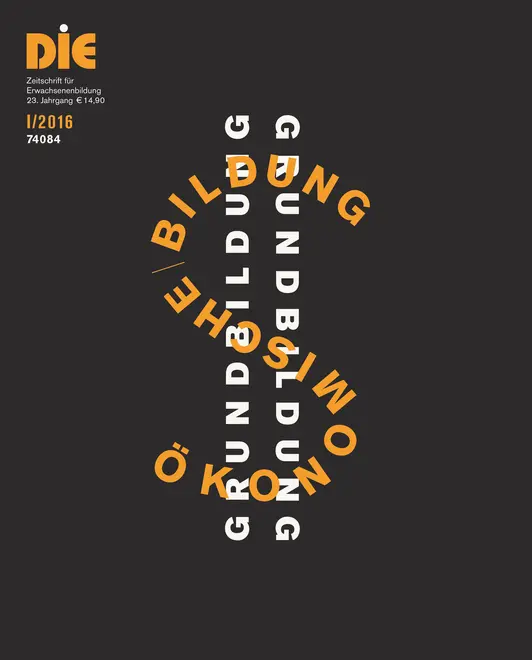
Ökonomische Bildung
wbv
Ökonomische Bildung
DIE Zeitschrift für Erwachsenenbildung
1/2016
Bielefeld
Abstract
Das Thema Ökonomische (Grund-)Bildung hat in den letzten Jahren zunehmend Auftrieb erhalten und ist auch in der Erwachsenen- und Weiterbildung angekommen: Mit der Integration ökonomischer Bildung in Literacy-Diskurse ist sie weiterbildungspolitisch in den Erwartungshorizont an öffentliche Daseinsvorsorge eingezogen. Das Heft führt in die Debatte um ökonomische Erwachsenenbildung ein und gibt einen Überblick über bereits bestehende Praxis in diesem Bereich.
Content
Thomas Retzmann; Volker Bank
Stichwort: »Ökonomische Bildung« 1/2016, S. 20–21
Stichwort: »Ökonomische Bildung« 1/2016, S. 20–21
Bernd Remmele
Ökonomische Kompetenzen 1/2016, S. 22–25
Was sie umfassen und wie man sie misst
Ökonomische Kompetenzen 1/2016, S. 22–25
Was sie umfassen und wie man sie misst
The author addresses the assessment of adult economic competences. He also provides a short but critical overview of different approaches to measuring these competences.
Silja Graupe
Zwischen Marktgläubigkeit und Marktkritik 1/2016, S. 26–30
Plädoyer für eine Bildung zur ökonomischen Mündigkeit
Zwischen Marktgläubigkeit und Marktkritik 1/2016, S. 26–30
Plädoyer für eine Bildung zur ökonomischen Mündigkeit
Economic standard education is increasingly criticised for its unworldliness, imbalance and rashness. The article investigates possible effects and the social meaning of this condition: Does is support sightless market credibility, which is visible in the public opinion during the past decades? Which criteria play a role? The article pursues these issues by working out essential connections between strategies for influencing the public opinion from a historic perspective on the one hand, and science and education on the other hand, as it has been discussed in neoliberalism since the past century. In addition, a basic alternative educational reform, an education for economic maturity, is outlined
Miriam Claudi; Theresa Jung
»Ich möchte den Menschen einen Raum zum Nachdenken bieten.« 1/2016, S. 31–32
Gespräch miit Miriam Claudi über ökonomische Bildung, Kapitalismus und das gute Leben
»Ich möchte den Menschen einen Raum zum Nachdenken bieten.« 1/2016, S. 31–32
Gespräch miit Miriam Claudi über ökonomische Bildung, Kapitalismus und das gute Leben
Günther Seeber
Bedarfe an ökonomischer Grundbildung 1/2016, S. 37–40
Forderungen, Bestimmungen, Verantwortlichkeiten
Bedarfe an ökonomischer Grundbildung 1/2016, S. 37–40
Forderungen, Bestimmungen, Verantwortlichkeiten
The article refers to the demand for adult economic literacy as well as its objectives. Present demands require intensification. These demands are evident in the behaviour of educational consumers and providers, and even more so in the social expectations expressed by all relevant groups. The text concludes with a reference to the particular public responsibility to provide suitable programmes.
Dr. Ewelina Mania; Monika Tröster
Lernangebote im Bereich Finanzielle Grundbildung 1/2016, S. 41–44
Anwendungsmöglichkeiten des CurVe-Kompetenzmodells
Lernangebote im Bereich Finanzielle Grundbildung 1/2016, S. 41–44
Anwendungsmöglichkeiten des CurVe-Kompetenzmodells
This report deals with the significance of the competence model for requirements of daily money management, which was developed in the project "CurVe". It particularly stresses the programme development in the field of financial literacy. In conclusion, the challenges of establishing financial literacy as part of the programme literacy and basic education are outlined.
Ingrid Ambos
Anbieter und Angebote ökonomischer (Grund-)Bildung 1/2016, S. 45–48
Ergebnisse einer Bestandsaufnahme
Anbieter und Angebote ökonomischer (Grund-)Bildung 1/2016, S. 45–48
Ergebnisse einer Bestandsaufnahme
Who are the key players in the field of adult economic literacy? How can continuing education programmes be characterised e.g. from a thematic and content-related perspective? Based on findings gained in a survey on the current programme situation conducted by the DIE, the article provides an overview of the German landscape.