Publications

Netzwerkforschung

Placeholder
Prof. Dr. Dr. h.c. Ekkehard Nuissl
wbv
Netzwerkforschung
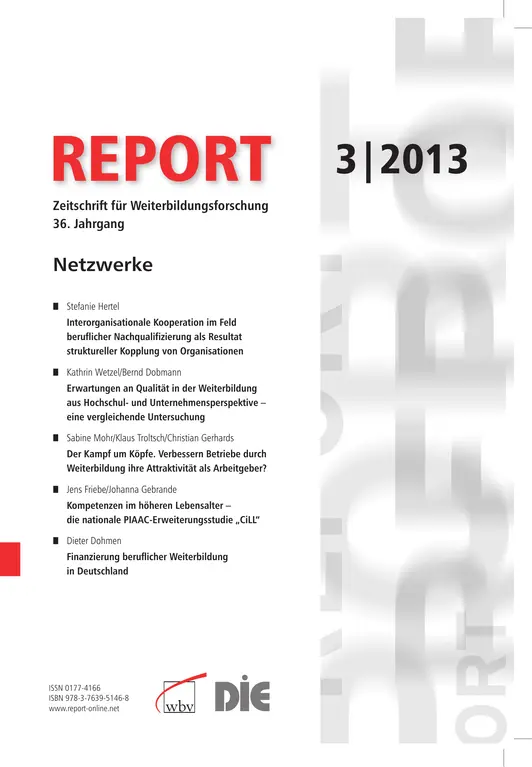
REPORT Zeitschrift für Weiterbildungsforschung
10/2013
Bielefeld

Abstract

Kooperationen und Netzwerke sind zu einem immer bedeutsameren Verfahren der Zusammenarbeit geworden, haben im Rahmen politischer Steuerung und institutioneller Entwicklung gerade auch im Bildungsbereich an Bedeutung gewonnen. Entsprechend nahm auch ihre Erforschung zu und differenzierte sich. Der REPORT bietet mit diesem Thema die Möglichkeit, Forschungsergebnisse aus erziehungswissenschaftlicher, soziologischer und politikwissenschaftlicher Perspektive zur Rolle, Gestalt und Wirkung von Netzwerken im Bildungsbereich vorzustellen. Der Schwerpunkt ist dabei die Erwachsenenbildung. Der Blick kann sich sowohl auf die Netzwerke selbst (Struktur, Steuerung, Abläufe, Kommunikation, Verantwortung, Entscheidung etc.) als auch auf die Konsequenzen für die Netzwerkpartner (Ressourcen, Organisationsentwicklung, Profil, Arbeitsfelder etc.) als auch auf den Netzwerkkontext (Außen-/Innenwelt, Konkurrenzen, Nachhaltigkeit, Dynamik etc.) richten. Mit dem Thema will der REPORT bestehende Forschungslinien aufzeigen und zu weiteren Forschungen anregen.

Content

Inter-organizational cooperation is understood as a possibility to react on the needs of low skilled adults through the conception of adequate offers. The conception and implementation of new second chance qualification offers that provide a vocational qualification for adults does not only require organizations in the educational system. Also further partners are needed to combine different services across system boundaries that correspond to the educational and to the economic system. The systems theory approach is outlined to use the term of structural coupling for a theoretical support to describe cross-system cooperation. Against this background an exemplary interview passage illustrates a cooperative relationship of organizational representatives belonging to the educational and to the economic system to demonstrate the problemsolving potential of inter-organizational cooperation.

This paper shows which quality standards are relevant for higher education and business perspective in the development and establishment of successful occupational studying programs. The aim is to record the expectations of universities and companies of quality in the context of continuing higher education. The level of the students is deliberately not placed in the center to allow the institutional view on cooperation. The methods used in connection with these studies are guideline-based interviews with selected universities and companies. In the following, first research results are brought forward and discussed on the base of existing quality criteria for continuing higher education. The identified expectations of universities and companies were compared with each other and first quality standards are being developed and now can be used as quality standards in occupational study programs.
Kathrin Wetzel; Bernd Dobmann

Based on considerations of the signaling theory and the reputation approach this study examines whether a relationship between employer-provided continuing vocational training and the success of establishments to recruit external qualified staff, can be demonstrated. The empirical analysis is based on a survey of establishments in Germany carried out in 2011. The results of a multivariate analysis show that establishments with continuing vocational training are more successful in recruiting qualified staff than establishments without continuing vocational training. This confirms that employer-provided continuing vocational training is not only an instrument of internal human resource development but also unfolds an effect on external recruiting processes.
Klaus Troltsch; Sabine Mohr; Christian Gerhards

First results from the PIAAC survey, which was conducted in 25 countries, will be published in October 2013 by OECD. PIAAC collected information about adult competencies through representative data from a background questionnaire and from assessments of three competence domains. In Germany exists an additional study called "Competencies in Later Life" (CiLL), which is designed for people (aged) between 66 and 80 years. This article presents the context of the study, the process of data collection of older adults as well as some first results.
Dr. Jens Friebe; Johanna Gebrande

The Financing of vocational adult education has changed a lot over the last decade. Demand-led funding instruments were introduced at federal as well as state level, aiming to support various (target) groups. The paper reviews, whether these funding instruments addressed special gaps in the funding system and tries to provide first and preliminary impressions whether and to what extent these instruments might have contributed to increasing participation rates in Germany. The analysis suggests that some fundings gaps were addressed, though to a different extent. However, it appears that the impact towards increasing participation rates is rather limited.

Print:
Link copied to clipboard!

Search

Current topics: